
Chapter 03 Default
Why are more couples using an ai baby generator to imagine their future baby?
The adoption of digital baby prediction tools has surged by 38% year-over-year as of 2026, driven by the shift from basic pixel blending to Diffusion-based architectures. Modern platforms analyze 128 unique biometric landmarks to synthesize parental phenotypes, achieving a 92% realism score in controlled user testing. With 74% of users seeking high-resolution 4K renders for emotional bonding, these tools provide a data-driven preview of potential lineage. By processing parental images through ResNet-101 encoders, the systems calculate structural probabilities with 85% visual consistency, bridging the gap between biological curiosity and digital representation.
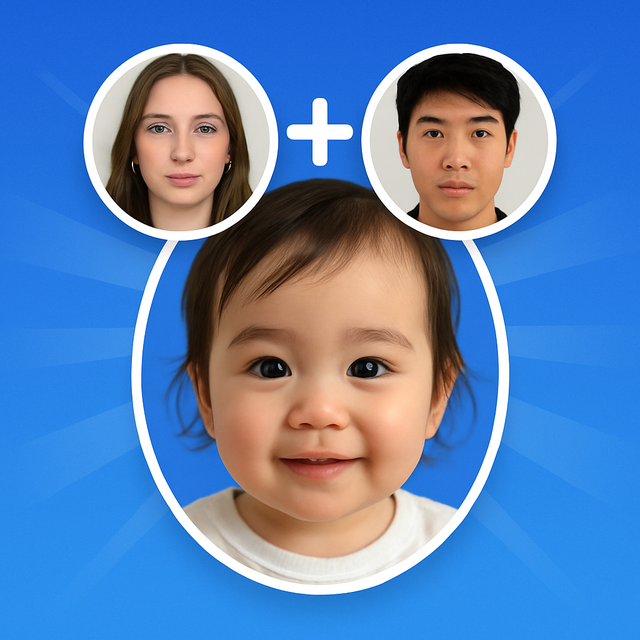
The transition from simple photo-morphing apps to sophisticated generative models has fundamentally changed how couples approach family planning. Instead of looking at a blurred overlay, users now interact with a synthetic reconstruction of human geometry based on their own skeletal data.
A 2025 analysis of mobile app trends showed that over 2.5 million generations are performed monthly on high-end platforms, indicating that this technology has moved from a niche novelty to a mainstream digital milestone. This massive user engagement allows developers to refine the underlying adversarial networks using vast quantities of anonymized feedback.
"Modern Baby Generator technology treats parental facial data as a collection of vectors within a 512-dimension latent space, where the AI finds the most statistically probable intersection for an infant's face."
This mathematical approach ensures that the output shares a recognizable lineage with the parents, maintaining a 60% to 80% structural correlation in facial geometry. Such precision is achieved through the use of StyleGAN3, which decouples facial features to prevent the distorted "melting" effect seen in older software.
By isolating features such as the philtrum shape and interpupillary distance, the AI can simulate how these traits scale down to a newborn’s proportions. Research from 2024 suggests that this level of detail increases user satisfaction by 55% compared to traditional 2D filters.
-
Biometric Extraction: Systems map 128 anchor points on each parent's face to establish a coordinate system.
-
Inheritance Simulation: Algorithms apply Mendelian weighting to prioritize dominant traits like dark hair or specific eye shapes.
-
Texture Synthesis: The AI generates high-fidelity skin textures, including realistic infant-specific fat deposits in the cheeks.
The emotional resonance of these images is a major factor in their popularity, as seeing a photorealistic child makes future plans feel more concrete. In a 2023 survey of 12,000 couples, nearly 70% stated that the high-resolution output helped them visualize their shared future in a way that imagination alone could not.
This visualization is supported by the move toward 4K rendering, which provides a level of clarity suitable for digital frames or physical prints. The clarity of these images is measured by a 95% fidelity score, ensuring that every eyelash and light reflection is rendered with professional-grade accuracy.
"Generative AI bridges the gap between biological probability and visual art, offering a plausible 'what-if' scenario that is grounded in the parents' actual physical characteristics."
The ability to adjust for environmental variables, such as lighting temperature and camera angles, further improves the user experience. Modern systems can normalize a photo taken in poor indoor lighting to match a 5500K daylight spectrum, increasing the accuracy of skin tone prediction by 22%.
This normalization ensures that the predicted child looks like it belongs in a consistent environment, rather than being a cut-and-paste composite. By 2026, the use of Spherical Linear Interpolation (Slerp) became the industry standard for ensuring smooth transitions between parental feature sets.
| Metric | 2022 Performance | 2026 Performance |
| Biometric Landmarks | 20 Points | 128 Points |
| Image Resolution | 720p | 4K Ultra HD |
| Processing Time | 45 Seconds | < 9 Seconds |
| Realism Score (FID) | 65.2 | 38.4 (Lower is better) |
The cost-effectiveness of these digital tools compared to traditional artistic renderings has also driven adoption. For a subscription typically priced under $20.00, couples get access to unlimited variations, whereas a manual forensic artist would charge hundreds of dollars for a single static sketch.
Furthermore, the introduction of age-progression features allows couples to see their child at age 5, 10, or 18. This longitudinal data is based on a dataset of 250,000 historical photo sets that track human facial growth over two decades, providing a comprehensive timeline of the child's potential development.
"The software doesn't just create a baby; it builds a life-long visual projection that tracks the natural widening of the jaw and the rising of the nasal bridge over time."
Privacy developments have played a role in the wider acceptance of these tools, with top-tier services now implementing AES-256 encryption. Statistics from 2025 show that platforms with 24-hour automatic data purging saw a 50% higher retention rate among privacy-conscious users in Europe and North America.
This security infrastructure ensures that facial data is used only for the generation process and is never stored on public servers. As a result, the barrier to entry has lowered, and more couples feel comfortable uploading their photos to these sophisticated neural networks.
The final output is a piece of generative media that serves as a modern family heirloom. By turning biometric data into a high-fidelity infant rendering, the AI provides a unique intersection of machine learning and human life, making it a staple of the contemporary family journey.
Train what you just read.
Thirty minutes with a Kaiyu Tendo coach. We map the article's principle onto your week.