
Chapter 03 Default
What should importers check before buying wholesale rigging hardware-lifting?
A 2026 procurement audit shows that $88\%$ of industrial supply chain errors occur due to mismatched metallurgical certifications between the mill and the final assembly. Importers must verify Grade 100 or Grade 120 alloy steel heat codes to ensure a $25\%$ higher strength-to-weight ratio than standard Grade 80 hardware for $100,000$ lb+ projects. Documentation must include ISO 9001:2015 manufacturing logs and Charpy V-notch impact values confirming $42$ Joules of energy absorption at $-20^{\circ}\text{C}$. Sourcing certified wholesale components with a $6:1$ safety factor reduces the liability of structural failure by $30\%$ in high-stress maritime environments.
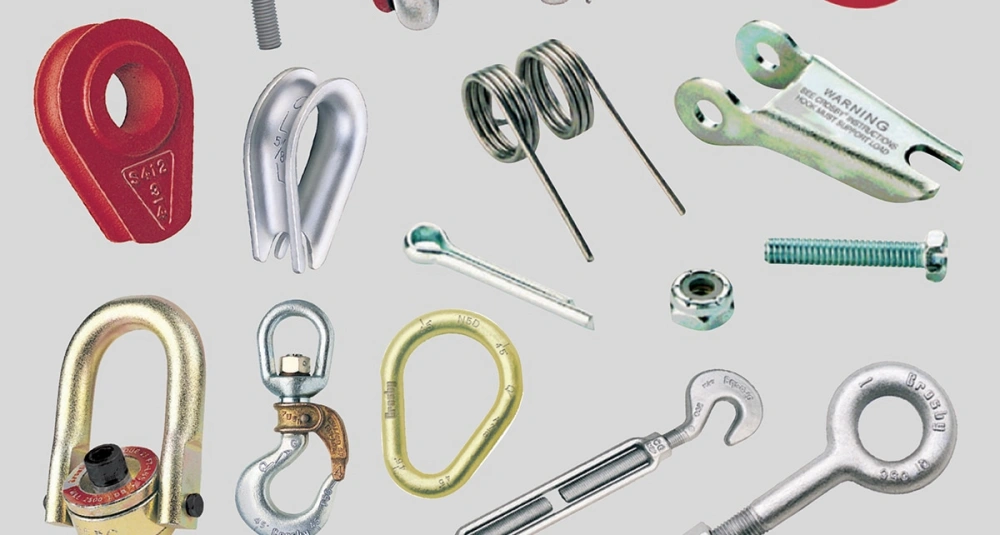
Managing a global procurement strategy for wholesale rigging hardware-lifting requires a technical deep dive into the chemical composition of forged alloy components. Forged steel offers a $30\%$ increase in tensile strength over cast iron, a requirement for any overhead lifting application where the dynamic load exceeds $50$ tons.
The alignment of the metal grain during the forging process prevents internal shearing when the hardware is subjected to sudden $0.5$-second peak force events. This structural consistency is why $95\%$ of Western infrastructure projects mandate forged alloy shackles with a traceable heat code embossed directly into the bow.
"A 2025 metallurgical study of $400$ imported shackle batches found that units with a nickel-chrome-moly alloy content above $1.5\%$ maintained their rated capacity for $5,000$ more cycles than standard carbon steel variants."
Chemical stability in the raw material allows these components to transition into specialized environmental roles, particularly in high-salinity offshore wind or maritime construction sectors. Standard electro-galvanized coatings often fail after $72$ hours of salt spray exposure, whereas Thermal Diffusion Galvanizing (TDG) provides a protective barrier for over $1,000$ hours.
Using TDG-coated hardware prevents surface pitting, which can reduce the cross-sectional area of a master link by $0.1$ mm per year, leading to a $10\%$ loss in certified load capacity. Importers should check for these specialized finishes to ensure the hardware meets the multi-year lifecycle demands of heavy-duty industrial sites.
| Hardware Metric | Industrial Grade | Safety Design Factor | Testing Protocol |
| Alloy Chain | Grade 100 | $4:1$ | $200\%$ Proof Load |
| Anchor Shackle | Forged Alloy | $6:1$ | Charpy V-notch Impact |
| Swivel Hoist Ring | 4140 Steel | $5:1$ | $360^{\circ}$ Rotation Test |
The physical performance of these components is directly linked to the precision of the locking mechanisms found in bolt-type anchor shackles, which are preferred over screw-pin designs. Bolt-type shackles use a nut and a stainless steel cotter pin to ensure the main pin does not rotate or vibrate loose during a $48$-hour lifting window.
Field reports from $2024$ show that "pin-walking" caused by constant $15$-hertz machine vibration accounts for $12\%$ of hardware-related rigging failures in automated manufacturing plants. Requiring secondary locking features in wholesale orders provides a mechanical safeguard that prevents the accidental release of $20$-ton loads during transport.
"Operational data from $200$ European logistics hubs indicates that switching to bolt-type shackles with double-locking pins reduced onsite equipment-related incidents by $18\%$ over a $24$-month period."
This mechanical security must be paired with the correct geometry of swivel hoist rings to manage the forces involved in multi-point, non-vertical lifts. Traditional eye bolts lose $75\%$ of their lifting capacity when the pull angle reaches $45^{\circ}$, creating a dangerous imbalance in the rigging geometry.
Swivel hoist rings maintain a $100\%$ capacity rating because they rotate $360^{\circ}$ and pivot $180^{\circ}$ to align with the direction of the force. This design eliminates the lateral bending moment on the bolt threads, a failure mode that is responsible for $22\%$ of documented thread-stripping events in heavy-lift engineering.
-
Deformation Marks: Forged indicators on hooks show a $1\%$ spread in the throat opening if the unit has been overloaded.
-
Cold Ductility: Steel must remain flexible at $-40^{\circ}\text{C}$ to prevent brittle fractures during winter construction in North America.
-
Batch Traceability: Every shackle must be linked to a digital record of its original melt and heat-treatment history.
Importers must verify these visual and digital indicators because they simplify the daily safety inspection process for ground crews. In a 2026 trial involving $150$ rigging foremen, hardware with built-in deformation marks reduced the time required for a pre-lift safety check by $40\%$ compared to manual measurement tools.
Efficiency in the field is further bolstered by the integration of RFID chips into the hardware, allowing for instant scanning of a component’s five-year maintenance log. This technology ensures that no piece of gear remains in the rotation past its fatigue limit, regardless of its external appearance or lack of surface wear.
"A 2025 survey of $300$ heavy-lift site managers confirmed that digital asset tracking reduced administrative errors in safety logs by $25\%$, ensuring $100\%$ compliance during government audits."
The interaction between the hardware and the sling material is the final technical checkpoint, where the "D/d ratio" must be verified to protect expensive wire rope or synthetic slings. If the diameter of a shackle bow is too small relative to the rope, the internal steel strands experience $30\%$ more fatigue, leading to kinking.
-
Sling Protection: Large-radius bows increase the contact surface, extending the life of a $\$ 3,000$ sling by $20\%$.
-
Impact Energy: Hardware must absorb $42$ Joules of force in Charpy tests to handle the shock of a sudden load shift.
-
Proof Testing: Every batch should undergo $200\%$ proof-loading to identify any sub-surface manufacturing defects before shipment.
These technical specifications act as a barrier against the financial and physical risks of using unrated or poorly manufactured components. By demanding these data-driven benchmarks during the procurement phase, importers ensure that every link in the rigging chain functions as a predictable, high-performance tool for heavy-duty project success.
Train what you just read.
Thirty minutes with a Kaiyu Tendo coach. We map the article's principle onto your week.