
Chapter 03
How to Judge an ODM Fragrance Partner Before You Hand Over the Brief
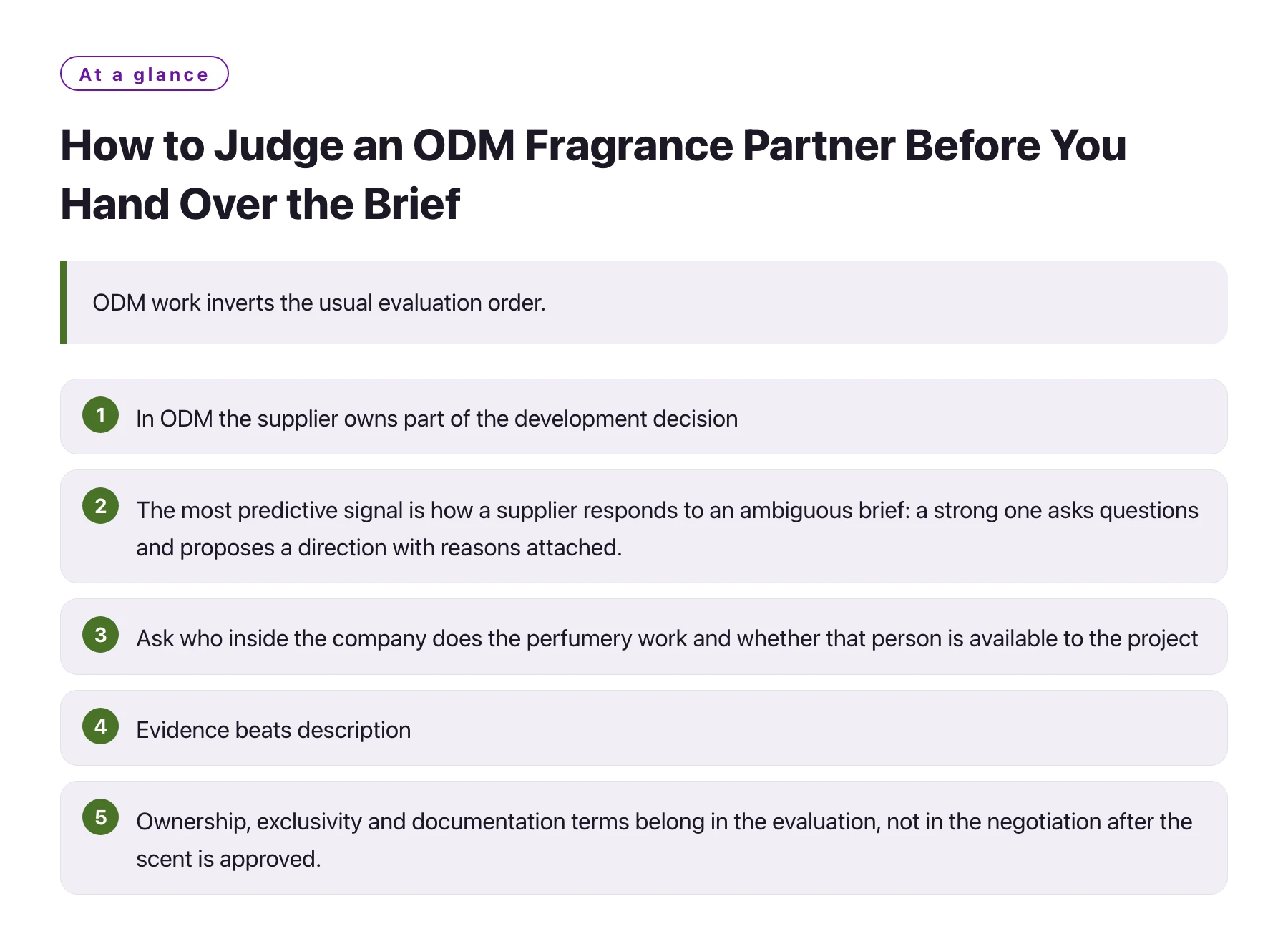
ODM work inverts the usual evaluation order. In OEM you know what you want and you are checking whether a factory can make it; in ODM the supplier takes over part of the deciding, so you are judging capability before the product exists. That makes the standard questions about capacity and price less useful than they look. The signals that predict a good ODM relationship are about how the supplier interprets a brief, what it hands over as evidence, and how clearly it separates its own decisions from yours.
Key takeaways
- In ODM the supplier owns part of the development decision, so the brief is a starting point rather than a specification.
- The most predictive signal is how a supplier responds to an ambiguous brief: a strong one asks questions and proposes a direction with reasons attached.
- Ask who inside the company does the perfumery work and whether that person is available to the project, because a named capability is not the same as an assigned one.
- Evidence beats description, so requests should be for documents, records and retained samples rather than for stories about past work.
- Ownership, exclusivity and documentation terms belong in the evaluation, not in the negotiation after the scent is approved.
The difference between OEM and ODM is easiest to see in the sentence a supplier uses to describe its own role. An OEM partner says it makes what the brand specifies. An ODM partner says it develops the product the brand sells. Both are legitimate, and the second arrangement carries a risk the first does not: the brand is delegating decisions it may later wish it had made itself.
Evaluation is therefore less about certificates, which many factories hold, and more about the working relationship. This is why the checklist below treats ODM fragrance development as a process to be inspected week by week rather than as a service to be compared on a price list ODM fragrance development. For an e-commerce brand that will reorder on sell-through rather than on a fixed plan, the questions are about speed of iteration, clarity of handover and how the partner behaves when a direction does not work.
A scorecard that asks for evidence rather than impressions
| What to evaluate | Weak signal | Strong signal | Evidence to request |
|---|---|---|---|
| Brief interpretation | A catalogue is sent in reply | Two or three directions are proposed, with a reason for each | Written response to your brief, with the direction it favours and why |
| Perfumery resource | Work is described as handled in-house without names | A named perfumer or team is assigned, with availability confirmed | Staffing structure, and the CV or project history of the person assigned |
| Development process | Number of sample rounds is not defined | Rounds, revision costs and a decision owner are stated up front | A development schedule with the approval points marked |
| Compliance handling | The brand is told to check the rules itself | The supplier prepares conformity and allergen documentation for the target market | A sample document pack from a previous project [1] |
| Industrial design | Bottle and packaging are treated as your problem | Mould options, decoration and pack engineering are part of the service | Examples of packs the supplier has engineered, with the decisions explained |
| Ownership and exclusivity | Terms are deferred until after approval | Scope is defined before development starts | A draft clause set for the development agreement |
| Third-party verification | Only internal test results are offered | External laboratory testing is part of the plan | The scope of testing and the laboratory used [2] |
Score the responses, not the personalities. A supplier that answers four rows with documents is more useful than one that answers all seven with confidence.
The question that reveals the most about an ODM partner
Send a deliberately incomplete brief. Not a trick brief, but a realistic one: a target user, a price point, a market and a mood, with no direction on notes or materials. Then watch what comes back.
A weak partner returns a price list and asks which library scent you would like. A strong partner returns one or two interpretations, explains what each would cost and how long it would take, and names the assumptions it made. That response tells you whether development is a real function or a label on a sales page.
The second most revealing question is what happens when a direction fails. Every development project includes at least one sample that misses, and the way a partner handles a miss is a preview of how it will handle a production problem. A partner that treats a rejected sample as information is a partner that will flag a deviation instead of shipping it.
Look at how the work is split inside the building
ODM services can be genuinely integrated or assembled from subcontractors, and neither is automatically wrong. What matters is that the split is disclosed. If compounding, filling or packaging is outsourced, the brand should know who is responsible when something goes wrong and how the work is documented across the boundary.
A useful comparison is the factory that keeps development and production under one roof against the arrangement where the scent is developed in one place and filled in another. The integrated version shortens the loop between a formulation decision and a production consequence, which matters most in the first order the stages of perfume production. The split version can be cheaper and more flexible, but it needs a named owner for the handover.
This is also where the OEM and ODM boundary becomes visible. A partner that genuinely supports both will explain when it would recommend a developed scent and when a library direction is the better commercial answer both OEM and ODM fragrance production, rather than steering every project toward the model with the higher development fee.
A four-week evaluation sequence that produces a decision
- Week one: the written briefSend a one-page brief with the target market, product category, price point and a deliberately open direction, and note how long the reply takes.
- Week two: the evidence packAsk for the documents behind one recent development project: the brief, the sample record, the compliance pack and the approval trail.
- Week three: the people conversationSpeak to the person who would actually work on your project, not only to the sales contact, and ask what they would change about your brief.
- Week four: the terms draftAsk for the ownership, exclusivity and termination language before any sample is made, and see how willing the partner is to put scope in writing.
One trap to avoid: evaluating an ODM partner on the quality of a scent they showed you. The sample is the output of a previous project with a different brief, different budget and different constraints. What transfers between projects is the process, not the scent.
Sources
- IFRA Standards Library (International Fragrance Association) —— The IFRA Standards Library lists the restrictions the fragrance industry applies to individual fragrance ingredients, based on safety assessments; it is the reference point for compliant fragrance formulation.
- SGS: Cosmetics, Personal Care & Household Testing —— Testing, inspection and certification services for cosmetics and personal care, including microbiological, stability and safety testing aligned with cosmetics GMP.
Frequently asked questions
What is the difference between OEM and ODM for a fragrance brand?
In OEM the brand specifies the product and the factory produces it. In ODM the factory also takes responsibility for developing the scent and often the packaging concept, so the brand is buying a finished solution rather than executing its own specification.
Should a first-time brand start with ODM?
Often yes, because ODM reduces the number of decisions a new team has to make and usually shortens the path to a first order. The trade-off is that the brand owns less of the differentiation and needs to be explicit about exclusivity terms.
How many sample rounds should an ODM partner include?
The number should be stated before development starts, along with the cost of additional rounds. A partner that leaves this open is transferring schedule risk to the brand.
What documents should an ODM partner provide?
At minimum a formula or specification record, a compliance pack covering the target market, safety and allergen documentation, and a retained reference sample. The exact list depends on where the product is sold.
Is a larger ODM supplier always the safer choice?
No. Larger suppliers bring capability and process but may assign less attention to a small first order. What predicts a good outcome is whether a named person is accountable for the project and whether the partner documents its decisions.
Train what you just read.
Thirty minutes with a Kaiyu Tendo coach. We map the article's principle onto your week.